When designing digital products, we often focus on functionality, aesthetics, and business goals. However, one crucial element determines a product’s success: the user. Understanding user behaviour, needs, and motivations is at the core of UX design, and ethnographic research provides a powerful tool to achieve this. In this article, we’ll explore the connection between ethnographic research, usability, and user research—and why it matters in building meaningful digital experiences.
What is User Research?
User research is about figuring out how people actually use products, rather than how we assume they do. Anyone who has conducted ethnographic research or is familiar with ethnology will tell you people lie – not in a despicable way, but they do. Some is cultural, some is psychological - either way they do.
For example, if you’re designing a logistics app, you might assume workers want a sleek, modern interface. But by observing them in their work environment, you may discover that they need large, bold buttons and minimal distractions because they are constantly on the move. Insights like this can make or break a product.
Or if you want to go even deeper ethnologically – on an interview with a Turkish person they will tell you what you want to hear and will behave in a way he/she thinks you expect him/her to. (This doesn’t apply only to Turkish people, but they are a good example I have worked with). It is a cultural thing, actually. It applies to any culture that grows up with the “What will people say?” mentality. Imagine growing up in an environment where you have to prove your neighbours, relatives but especially someone of an authority (that is you by the way – the designer) that you are special, someone worth it, and you will understand what I mean. I am a Balkan child so I am familiar with the concept a bit too much. My parents were quite the rebels of their time so I didn't taste this first hand but grow up around it.
First things first - User research is the process of studying how users interact with products, their expectations, and the challenges they face. It includes methods like:
• Surveys & Questionnaires – Gathering large-scale feedback.
• Interviews – Understanding user motivations and behaviours in depth.
• Usability Testing – Observing how users navigate a product to identify pain points.
• Field Studies & Ethnographic Research – Immersing in users’ environments to understand their real-world experiences.
Among these methods, ethnographic research offers unique insights that go beyond surface-level data.
What is Ethnographic Research in UX?
Let's make it short (unlike any ethnological research) - Ethnography originates from anthropology and focuses on studying people within their natural environment. Unlike usability testing, which happens in controlled settings, ethnographic research is conducted in real-world contexts—whether at home, at work, or in public spaces. It reveals how habits, cultural influences, and emotions shape behaviour, often uncovering unexpected patterns that standard research methods might miss.
It is about seeing beyond what people say.
Key Characteristics of Ethnographic Research
• Conducted in-context (at home, work, or in public spaces).
• Focuses on real behaviors instead of hypothetical scenarios.
• Uncovers cultural and emotional influences on user decisions.
For example, if you’re designing a logistics platform, observing how warehouse workers interact with existing tools can reveal pain points they might not mention in an interview.
Marketing Has Been Using It for Years
While UX design is just beginning to embrace ethnographic research, marketing and product development teams have relied on it for decades. Many well-known brands have used these methods to shape their products and services.
Take SUVs, for example. Car manufacturers didn’t just guess that people wanted bigger vehicles. By observing how families used their cars, they realized that space and a sense of security were top priorities, leading to the SUV boom mainly in the US. Procter & Gamble did something similar by watching how people clean their homes. They noticed small frustrations—like struggling to wring out a mop—and used these insights to develop better cleaning products.
Even tech companies like Apple and Google employ anthropologists to study how people interact with technology in real life. This kind of research isn’t just about selling more—it’s about making products that fit seamlessly into people’s lives – which of course results in profit, iconic products and... well profit.
Ethnographic Research vs. Usability Testing
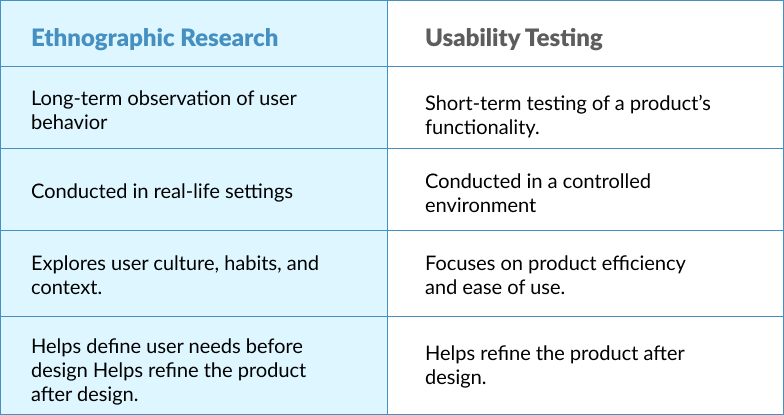
A strong UX strategy combines both—ethnographic research to inform design decisions and usability testing to refine them.
How to Conduct Ethnographic Research in UX
So, how do you do it? Here’s a simple guide to conducting ethnographic research without overcomplicating things.
Step 1: Define What You’re Looking For
Before diving in, you need a clear goal. What are you trying to understand? Maybe it’s how people use recycling apps in different cities or how factory workers interact with digital tools on the job. A focused goal keeps your research useful and prevents it from becoming a wandering observation exercise.
✅ Keep it specific. Vague goals lead to vague results.
✅ Think about context. Where do users interact with your product?
✅ Tie it back to your project. Every insight should serve a purpose.
Step 2: Find the Right People
Not all users are the same, and that’s the point. You need diversity—in demographics, habits, and environments, even education sometimes. The more perspectives you get, the richer your insights.
✅ Choose participants who actually use (or would use) your product. Don't forget there is no product EVERYONE loves or needs.
✅ Mix it up. Don’t just study “average” users—edge cases reveal surprising insights.
✅ Use screening questions. This helps filter out people who aren’t relevant to your study.
Step 3: Observe Without Interfering
This is where the magic happens. You step into the user’s world—whether that’s their home, office, or local coffee shop—and watch how they interact with technology naturally.
✅ Be a fly on the wall. The less you interfere, the more authentic the behaviour. But don’t make them uncomfortable and freak them out pretending to be an actual fly...
✅ Ask open-ended questions. “Why did you do that?” is better than “Do you like this feature?” Don't give advices.
✅ Pay attention to the little things. Frustrations, workarounds, and unconscious habits are goldmines.
Step 4: Capture Everything (But Respect Privacy)
You’ll never remember every detail, so document as much as you can—notes, photos, even video recordings (with consent, of course). This helps later when you’re looking for patterns.
✅ Keep structured notes. It’ll make analysis easier.
✅ Visual cues matter. Photos and videos can reveal insights you didn’t catch in the moment.
✅ Write down direct quotes. People express pain points in ways no data chart ever could.
Step 5: Turn Insights Into Action
Now that you have all this information, what does it actually mean for your design? Look for patterns—common struggles, unexpected behaviours, recurring themes. Then, apply these insights to make your product better.
✅ Group similar observations to spot key themes.
✅ Create user personas and journey maps to bring your research to life.
✅ Use these findings to refine your design. Small tweaks can make a huge difference.
Why It’s Worth It
Or is it worth it? It is! Sometimes could be seen as an overkill, I'll admit, but it is...
Numbers and surveys give you part of the picture, but they miss the deeper, real-world experience of your users. Ethnographic research helps bridge that gap. It’s the reason some products feel intuitive while others feel like they were designed in a vacuum, or like Fast Fashion - nothing new or exciting about them.
Marketing teams have known this for years - UX designers should do the same. Because great design isn’t just about features—it’s about understanding people.
If you’re working on a project and want to integrate real-world insights, give ethnographic research a shot. You might be surprised by what you discover
Final Thoughts
Like it or not we live in a world where technology constantly evolves, understanding human behaviour, though, remains timeless. Ethnographic research brings depth, empathy, and real-world context to UX design, leading to more intuitive and user-friendly products. When combined with usability testing and other user research methods, it becomes a powerful tool for creating designs that truly serve people’s needs.
Marketing and product development teams have long understood the value of ethnography—it’s time for UX designers to fully embrace it too.